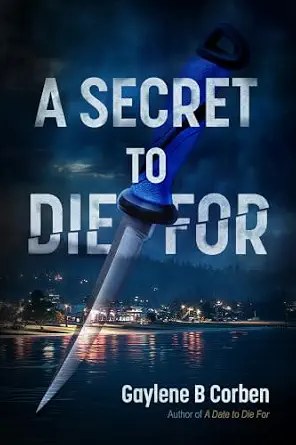
A Secret to Die For
Gaylene B Corben
A character-driven Australian mystery where old friendships become evidence, buried grievances become motives, and almost everyone has something left unsaid.
— BlurbCraft Studio
Read the full editorial review
Gaylene B Corben opens “A Secret to Die For” with a murder whose victim knows his killer — and then builds an absorbing mystery around the far more difficult question of whom everyone else can trust.
When police photographer and law student Olivia Chatfield is arrested for the murder of Brendan Taylor, the evidence against her appears disturbingly persuasive. For Detective Joe Paterson, however, accepting that evidence would mean accepting that the woman he loves is capable of murder. His refusal to do so sends him, alongside the perceptive Tessa, into the tightly connected community of White Sands, where old friendships, buried grievances and secrets stretching back years complicate an investigation in which almost everyone seems to know something they have not said.
Corben’s great strength is the human architecture surrounding the crime. This is not simply a hunt for a killer; it is a study of what happens when violence enters a community accustomed to familiarity and trust. Friends become suspects, remembered conversations acquire new meanings, and seemingly ordinary relationships reveal fault lines beneath them. The novel’s movement between events before and after the murder allows those relationships to accumulate significance as Joe’s investigation progresses.
The mystery is generously populated, but Corben keeps its emotional centre firmly anchored in Olivia and Joe. Olivia’s imprisonment gives the investigation genuine personal consequence, while Joe’s determination to establish the truth never entirely overwhelms his responsibilities as an investigator. Their relationship lends warmth to a story increasingly concerned with betrayal, manipulation and the frightening possibility that the person one thinks one knows may never have existed at all.
There is an appealingly traditional quality to Corben’s mystery-making. Interviews matter. Timelines matter. Alibis shift. Small inconsistencies accumulate. Suspects are eliminated and new possibilities emerge. Rather than depending solely upon a last-minute trick, the novel invites readers to travel through the investigation and reconsider what they thought they understood.
By the time “A Secret to Die For” reaches its confrontation, its title has acquired considerably more weight than its initial murder suggests. Corben delivers a character-driven Australian mystery about friendship, deception and the destructive longevity of secrets, while leaving enough room amid the darkness for affection, humour and hope.
For readers who prefer their murder mysteries rich in relationships as well as suspects, “A Secret to Die For” offers both a puzzle to unravel and people worth caring about while doing it.